

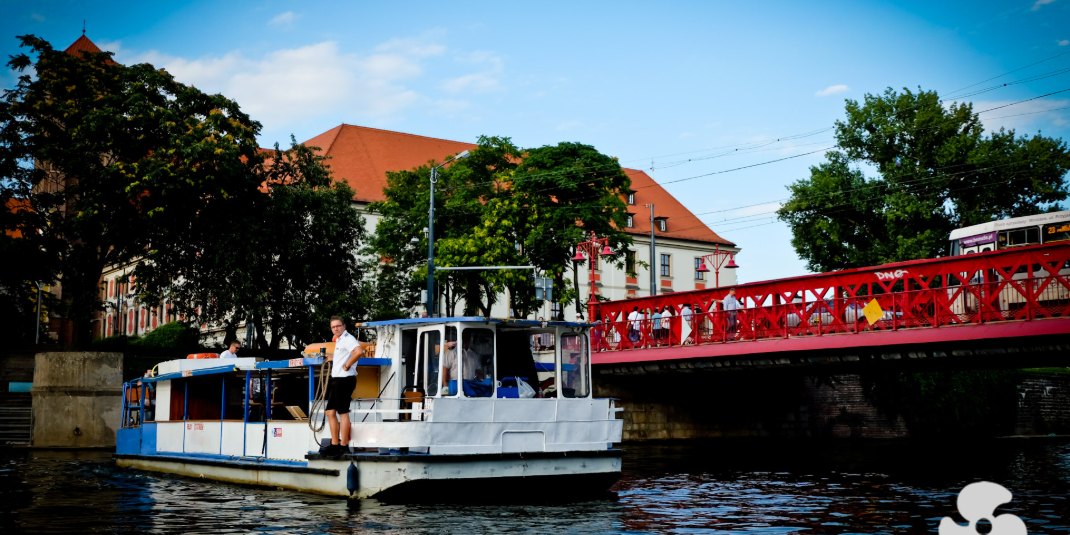
Wroclaw bridges are best seen from below – from the deck of a boat. From the water you can make out the rivets, the stone mascarons and the granite pylons you’d never even notice from the road. We’ve gathered some fun facts about the crossings over the Oder in the city centre, so you’ll have plenty to talk about between songs on your cruise.
A quick disclaimer before we start: the route of a private cruise is agreed individually, so which bridges you’ll sail under depends on the plan for your party. Treat this article as a cheat sheet – you’ll pass some bridges up close and see others from a distance.
Wroclaw bridges by numbers – how many are there, exactly?
It depends on what you count. According to the city’s official website, wroclaw.pl, the municipal roads authority looks after 111 bridges and 38 footbridges – the most in Poland. Wroclaw is also among Europe’s leaders; the cities ahead of it include Venice, Amsterdam, Hamburg and St Petersburg. Hence its nickname, the “Venice of the North”.
The history of the city’s crossings goes back to the Middle Ages: the first recorded mention of a bridge in Wroclaw dates from 1149 and refers to a link between Sand Island (Wyspa Piasek) and the left bank of the Oder. If you’d like to see some of these places from dry land as well, the city has described a walking “Bridges and Crossings” tourist trail (in Polish).
Wroclaw’s oldest crossings – Ostrów Tumski and Sand Island
Tumski Bridge
This riveted steel bridge from 1889 links Sand Island with Ostrów Tumski (Cathedral Island); until 1945 it was known as Cathedral Bridge. For years, couples in love hung padlocks on it – before the renovation every single one was removed, and together they weighed around 17 tonnes. Today the bridge is painted deep green, and lamps styled on the pre-war originals stand on its abutments.
A fun fact for the cruise: in the past you had to take your hat off when stepping onto the bridge, because this was where land under church authority began. The rule applied even to crowned heads.
Piaskowy Bridge
It leads from the Old Town to Sand Island, right next to the Market Hall (Hala Targowa). The current bridge, built in 1861, is the oldest of Wroclaw’s bridges to have kept its original steel structure.
Młyńskie Bridges, Słodowy Bridge and St Clare’s Bridge
The Młyńskie (Mill) Bridges from 1885 still have their original Schwedler-system steel girders. Between the islands, over narrow channels, you’ll find two record holders: Słodowy Bridge – the shortest in the city at just 8.5 m – and St Clare’s Bridge (most św. Klary), whose predecessor dates from 1799. It’s the oldest crossing in Wroclaw still in use, linking Słodowa Island with Bielarska Island.
Crossings by the University of Wroclaw and Słodowa Island
Pomorskie Bridges
The most decorative part is the southern section, completed in 1905 to a design by Karl Klimm, with clinker-brick arches inspired by Gothic architecture. After a thorough renovation, 68 mascarons – sea creatures and wolves – were returned to it, lit so that you can see them after dark too.
University Bridges
They were built in 1933–1934 on the site of earlier crossings from 1869, right next to the main building of the University of Wroclaw. From the water, they give you one of the best shots of the university’s façade and its Mathematical Tower.
Słodowa and Piaskowa footbridges
The pedestrian footbridges are the younger part of this collection. The Słodowa footbridge from 2003, suspended from parabolic girders, connected Słodowa Island with the right bank of the Oder, while the Piaskowa footbridge links it with Sand Island.
Most Pokoju and the Grunwaldzki Bridge – the eastern part of a Wroclaw cruise
Most Pokoju (Peace Bridge) is a post-war prestressed-concrete structure from 1959 that replaced the Lessing Bridge, destroyed in 1945. Beneath it runs a walkway connecting the Dunikowski and Kaczyński boulevards – thanks to it, you can walk along the Oder all the way from Piaskowy Bridge to the Grunwaldzki Bridge.
The Grunwaldzki Bridge is the city’s calling card. It was built in 1908–1910 and officially opened on 10 October 1910. It’s a suspension bridge, but its deck is held up not by cables or chains but by bands of flat-laid steel plates – according to wroclaw.pl, it’s the only suspension bridge of its kind in the world. It’s 112.5 m long, and its pylons are faced with granite.
Further east: Zwierzyniecki Bridge and Zwierzyniecka footbridge
The Zwierzyniecki (Zoo) Bridge from 1895–1897 is a piece of Art Nouveau in red sandstone, 62 m long. It leads towards the zoo and the Centennial Hall complex – though the hall itself doesn’t stand on the Oder, so don’t look for it from the deck. Also in this area is the Zwierzyniecka footbridge, the longest footbridge in the city (232.4 m).
Cruise cheat sheet: Wroclaw bridges from west to east
The order follows the city’s “Bridges and Crossings” trail, which runs along the Oder through the city centre. Print the table or save it on your phone – it’ll come in handy for a quiz on board.
| Bridge | Built | What to look out for |
|---|---|---|
| Pomorskie Bridges (southern section) | 1905 | clinker-brick arches and 68 illuminated mascarons |
| University Bridges | 1933–1934 | view of the University’s main building |
| Piaskowy Bridge | 1861 | oldest surviving original steel structure |
| Młyńskie Bridges | 1885 | Schwedler-system girders |
| Tumski Bridge | 1889 | green truss, the former “padlock bridge” |
| Most Pokoju (Peace Bridge) | 1959 | post-war prestressed-concrete structure |
| Grunwaldzki Bridge | 1908–1910 | suspension bridge with granite pylons |
| Zwierzyniecki Bridge | 1895–1897 | Art Nouveau in red sandstone |
Record breakers outside central Wroclaw
The Rędziński Bridge on the western edge of the city holds the Polish height record – it stands 122 m tall, and the whole crossing is more than 612 m long. It’s part of the motorway ring road, so it isn’t looked after by the city. Another one for your list of fun facts is the Oławski Bridge – the only baluster bridge in Wroclaw, which spans the Oława river rather than the Oder.
How to make the most of the bridges at a boat party in Wroclaw
- “Guess the bridge” quiz. Print a few fun facts from this article and run a contest: whoever recognises a bridge first picks the next song.
- Group photo with a bridge in the background. Agree on a moment for a group shot. You can order photo coverage as an extra, and it’s included in the VIP package.
- Cruise at dusk. The illuminated mascarons on the Pomorskie Bridges and the lights of Ostrów Tumski look their best after sunset – you’ll find the times in our article on the Wroclaw night cruise on the Oder.
- Safety. Under the bridges, don’t stand on the benches or lean over the side – follow the crew’s instructions.
You hire a private boat for 2 hours; in Wroclaw, packages start from €16 per person (Basic), €20 (Star) and €31 (VIP) for groups of 30 or more. You’ll find the details on our Wroclaw boat party page, and our boat party planning checklist and list of things worth bringing on a cruise will make your preparations easier.
FAQ – bridges in Wroclaw
How many bridges are there in Wroclaw?
According to the city’s website, wroclaw.pl, the municipal roads authority looks after 111 bridges and 38 footbridges. Other lists mention more than 120 bridges and crossings – the figure depends on what you count.
Which is the oldest bridge in Wroclaw?
The oldest crossing still in use is St Clare’s Bridge – its predecessor dates from 1799. Piaskowy Bridge, from 1861, is the oldest bridge to have kept its original steel structure.
Can you hang a padlock on Tumski Bridge?
No. Before the renovation, all the padlocks were removed from the bridge – together they weighed around 17 tonnes – and hanging them there is now forbidden. Couples leave their keepsakes on the railings along the Pawła Włostowica boulevard instead.
Which bridges will the boat pass under during the party?
That depends on the route, which we agree individually when you book. If a particular bridge or view matters to you, mention it in your enquiry.
Will we see Centennial Hall from the boat?
Centennial Hall doesn’t stand on the Oder. The Zwierzyniecki Bridge leads towards it and the zoo, but the hall itself is further inland.
A few fun facts about the bridges make a ready-made talking point for your cruise and a great excuse for photos. Pick a date, tell us which views matter most to you, and we’ll prepare an initial offer for your cruise on the Oder.
Book your private boat party
A private cruise in Wroclaw just for your group: two hours on the water, music and great views. Send us an enquiry and we’ll prepare an offer.